From Salesforce Opportunity to NetSuite Invoice
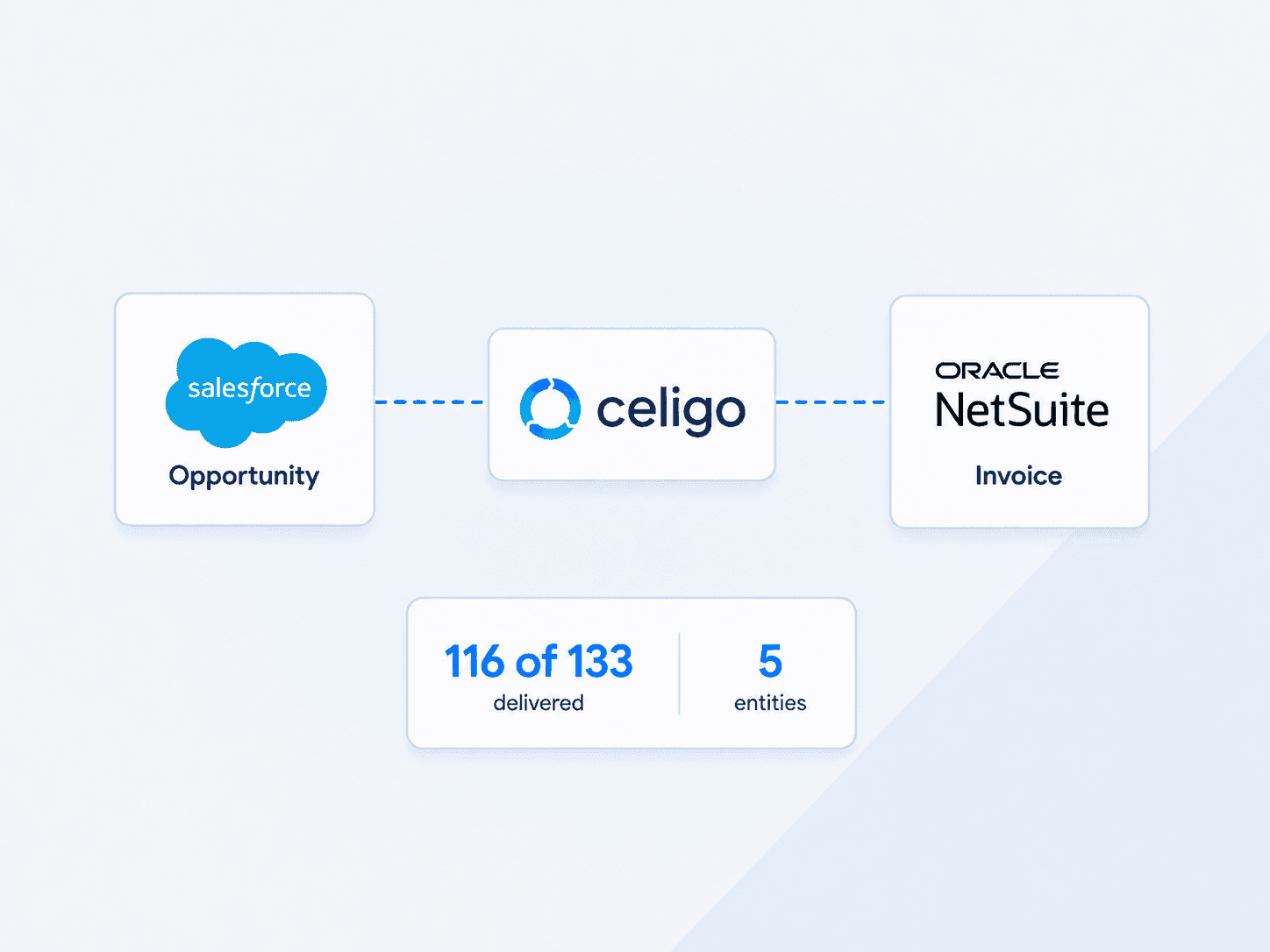
Salesforce and NetSuite were telling different versions of the same story, leaving teams to reconcile the differences downstream. We brought the systems—and the processes around them—back into alignment across five international entities.
Client
Global Advertising Technology Platform
Services
Digital Transformation
The Challenge
Every campaign had to move from a Salesforce opportunity through sales order and fulfillment to a NetSuite invoice without losing the details that made it billable. In practice, the systems disagreed about customer identity, product codes, billing emails, regions, tax information, and currency. Sales, account management, operations, and finance could not rely on one shared version of the campaign.
International billing raised the stakes. The United Kingdom, Japan, Australia, the Netherlands, and an acquired subsidiary each had different invoice formats, tax requirements, currencies, and customer-facing conventions. The work needed to improve the operating path without turning regional exceptions into a new collection of manual workarounds.
Our Approach
Make The Same Record Mean The Same Thing
The DORIAN Group treated the engagement as ongoing systems work rather than a one-time fix. Field mappings were standardized across accounts, opportunities, sales orders, product lines, fulfillments, and invoices. The Celigo connection between Salesforce and NetSuite was maintained and extended, with integration errors cleared as the underlying mappings became more consistent.
Rebuild Billing Around Each Entity
The customer-facing layer was rebuilt alongside the system connection. Invoice forms, credit notes, statements, dunning notices, and email templates were updated for regional requirements, including Japan-specific invoice logic, VAT detail for the United Kingdom and the Netherlands, currency handling, and subsidiary-specific reply-to addresses.
Automate The Handoff And Validate It
Delivery dates, classes, and campaign details now carry forward from sales order through fulfillment and onto the invoice. The remapping covered 961 opportunity regions, 538 opportunity-to-sales-order mappings, 209 account and customer records, and 121 product codes. Each change was tested in a sandbox and confirmed in production before release.
Map
Standardized data across accounts, opportunities, sales orders, product lines, fulfillments, and invoices.
Integrate
Maintained and extended the Celigo connection and resolved the integration errors it surfaced.
Localize
Rebuilt invoices, credit notes, statements, dunning notices, and email templates for regional requirements.
The Outcome
A total of 116 tracked requests were completed across revenue operations, finance, billing, integration reliability, and international compliance. Salesforce and NetSuite now describe the same campaign in the same terms, so changes move through the commercial and billing path correctly instead of appearing weeks later as reconciliation work.
The operating gain is a clearer line from opportunity to cash collected. CRM, fulfillment, billing, and finance can work from connected records while regional requirements remain explicit rather than hidden in manual exceptions.
Let's Build What's Next
Bring us the opportunity or change ahead.